
When I bought my Quest 2, it was for one reason only: fitness. That purchase was a commitment. VR was going to be my way of staying active, consistent, and motivated. My only solution was the KIWI Quest 2 controller grips, keep reading il explain why.
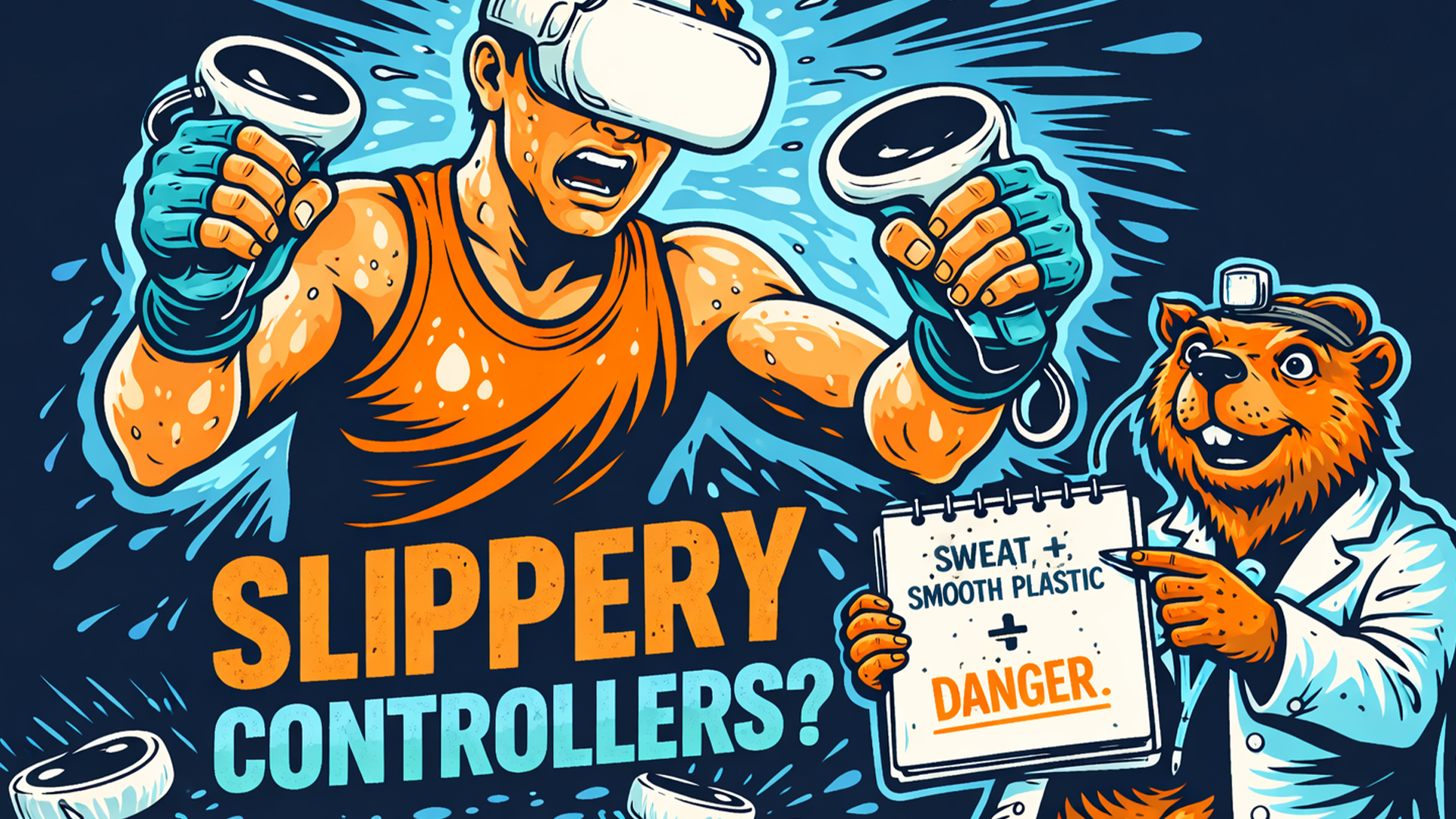
Two weeks into VR boxing, that plan almost fell apart. Not because of motion sickness or boredom, but because I had slippery controllers, and they would just fall off my hands.
The problem: After 20 minutes of boxing, my palms were soaked. The smooth plastic KIWI Quest 2 controller grips felt like bars of soap. Even with the generic wrist string that come with the quest2 on, I couldn’t grip confidently. Every punch felt cautious. Instead of focusing on form and breathing, my brain was stuck on one thought: Don’t slip controllers, stay on.
I tried gloves. Fabric wraps. Bandage tape. Nothing worked. My hands still slipped, and the extra layers made gripping feel awkward and tiring.
That’s when my imaginary Canadian beaver lab assistant, Will, stepped in with his notebook.
“Sweat plus smooth plastic equals danger.”
He was right.
Why Do Controllers Slip During VR Workouts?
VR fitness creates the perfect storm for slippery hands. High-intensity movement increases sweat production, especially in the palms. At the same time, you’re gripping tightly for extended periods.
KIWI Quest 2 controller grips are designed for general gaming: short sessions, moderate movement. Not sustained workouts where moisture control and grip endurance matter.
During boxing, I noticed a feedback loop. As my KIWI Quest 2 controller grips weakened from sweat, my hands fatigued faster. That fatigue made me squeeze harder. Squeezing harder caused even more fatigue and sweat. The cycle repeated. It was exhausting.
Will ran a very official lab test (also known as me paying attention). Punch speed and power dropped once grip fatigue set in. The more energy I spent just holding the controllers, the less energy I had for actual movement.
The solution needed to solve three problems:
- Reduce slipping (even when sweaty)
- Lower grip fatigue (so I could train longer)
- Improve confidence (so I could punch harder without fear)
What Actually Happens When Sweat Meets Smooth Plastic?
Will insisted we include some science here, so here it is.
Sweat creates a thin liquid layer between your skin and smooth plastic. That layer acts like a lubricant, lowering friction. With less friction, your hand must apply more force to keep the same grip.
Better traction changes this. Textured or rubberized surfaces increase surface contact and friction, even when moisture is present. When friction increases, you don’t need to squeeze as hard. That reduces muscle fatigue in the hands and forearms.
Will summarized it simply: “Less squeeze equals less fatigue. Less fatigue equals better performance.”
That’s when I decided to try KIWI Quest 2 controller grips.
KIWI Quest 2 Grips: What Changed Immediately
The first thing I noticed after installing the KIWI Quest 2 controller grips was texture. Instead of smooth plastic, my hands were wrapped in a slightly rubberized surface that felt secure immediately.
Installation took 5 minutes. The grips slide over the controllers and tighten with adjustable hand straps. You pull once, and you’re set. They also include a battery access flap, so you don’t need to remove the grips to change batteries.
I’ve been using mine for 2 years without issues.
Those adjustable straps made a massive difference. I snug them against my palms and then relax my grip. The straps do the holding, not my fingers. This allowed lighter grip pressure, smoother punches, and faster combinations with less tension in my forearms. I was basically going along for the ride.
Will reappeared mid-workout to remind me that relaxed hands equal better performance. He also added a boxing tip about using head weight as counterbalance during punches, which helped my endurance (but that’s a story for another article).
Bottom line: These grips are still one of the best investments I’ve made for my Quest 2.
Did the Grips Actually Reduce Hand Fatigue?
Yes, noticeably.
Before KIWI grips: Hand fatigue crept in around half threw my workout
After KIWI grips: I pushed well past 30-40 minutes with less discomfort.
The straps distribute pressure across the hand, so you hold the controller lightly but securely. Less tension means longer sessions. Longer sessions mean better endurance and better results.
From a practical standpoint, reduced hand fatigue also improved consistency. Fewer breaks. Better flow. More time actually moving instead of shaking out cramped fingers.
How Better Grip Improved Confidence and Immersion
Confidence sounds abstract, but in VR fitness it’s very physical.
When you’re not worried about dropping a controller, you move freely. Punches extend fully. Rotations feel natural. In Supernatural, this meant cleaner hits and smoother transitions. In VR boxing, I stopped pulling punches short.
One bonus I noticed was performance metrics. My speed and accuracy scores consistently reached 98% and higher. That kind of consistency only happens when movement feels natural.
Golf+ surprised me the most. A confident grip translated into smoother swings and better rhythm. Even though it’s lower intensity, immersion matters. A good golf grip is firm but relaxed, like holding a tube of toothpaste. The KIWI Quest 2 controller grips gave me that same feeling.
Will described it as the difference between holding a bar of soap and holding a power tool. Strange metaphor, but accurate.
How I Manage Sweat During Longer VR Workouts
KIWI Quest 2 controller grips don’t stop sweat, but they handle it far better than bare plastic. The textured surface maintains friction even when damp. After an hour-long session, the grip felt nearly the same as when I started.
I pair them with simple sweat management tools:
- Floor fan aimed at my play space (regulates temperature, reduces palm moisture)
- Microfiber cloth nearby (wipe controllers, headset, glasses, forehead between songs)
- Nose dilator for breathing (keeps airways open, reduces mouth breathing)
Ignoring sweat during workouts kills performance. Managing it protects your gear and your focus.
Are KIWI Quest 2 controller grips Useful Beyond High-Intensity Workouts?
While boxing showed the biggest improvement, lower-intensity activities benefited too. In Golf+, grip stability reduced mid-swing adjustments. Funny enough, VR golf even helped my real-world short pitch distance control.
Comfort matters during longer sessions, whether you’re pushing intensity or just moving lightly. Gear that supports both makes consistency easier.
When I tighten those straps at the start of a Supernatural session, my brain knows it’s go time.
What Gear Pairs Well with KIWI Quest 2 controller grips?
KIWI grips solve the hand problem, but VR fitness works best as a system.
My complete VR fitness setup:
- KIWI Quest 2 Controller Grips, you can also get it for the quest 3.
- Workout mat (defines play space, adds stability) this is what i use for my space
- Rechargeable batteries (reduces interruptions) I have the rechargeable unit, I had these fur for 2 years now, I change them when my controllers gets low.
- Floor fan (temperature control) simple yet effective
- Microfiber cloth (sweat management)
- Single kettlebell (warm-ups and cross-training)
Will insists the kettlebell is optional, but highly recommended for beavers training for lumberjack season.
Installation: Is It Easy?
Installation takes only a few minutes. The KIWI Quest 2 controller grips slide over the controllers and secure easily. No tools. No permanent modifications. They include an easy-access battery flap, so you don’t need to remove them when changing batteries.
Once installed, they stay in place. I’ve never needed to readjust them mid-workout, even during intense boxing sessions.
Ease of setup matters. If gear becomes annoying, it stops getting used. These passed that test.
Who Should Consider KIWI Quest 2 controller grips?
If you use your Quest 2 for VR fitness, especially boxing or rhythm-based workouts, these grips are a practical upgrade. They solve sweat, fatigue, and safety issues in one move.
You’ll benefit most if you:
- Do VR boxing (Supernatural)
- Train for 30+ minutes per session
- Experience hand fatigue or sweaty palms
- Want to improve punch speed and accuracy
- Play any game where grip confidence matters
Even casual users benefit from improved comfort and control. The more confident you feel holding the controllers, the more natural your movement becomes.
Were KIWI Quest 2 controller grips worth It for My VR Fitness Routine?
For me, yes.
They solved a real problem that was limiting my workouts. Less slipping. Less fatigue. More confidence.
After 2 years of daily use:
- Still in perfect condition
- No wear on the straps or rubber surface
- Battery flap still works smoothly
- Haven’t needed replacements
VR fitness should challenge your body, not your ability to hold onto a controller. KIWI Quest 2 controller grips shifted my focus back to movement, breathing, and enjoyment, which is where a good workout should live.
Related Articles
Want more VR fitness tips? Check out these guides:
- How I Stopped VR Lens Fogging (moisture management)
Download my free VR Fitness Warm-Up Routine – includes a routine that would warm your body for any intense VR fitness you starting.
I compare apps so you dont need too Read, hope it helps to make a decision.
Affiliate Disclosure
A quick word from my sponsors, also known as my wallet. As an Amazon Associate, I earn from qualifying purchases. If you click a link and buy something, I may earn a small commission at no extra cost to you. I only recommend products I personally own and use. If I mention something I haven’t tested yet, I’ll always say so. Transparency matters in fitness and in business.
1 thought on “How Slippery Controllers Almost Ruined My VR Fitness Routine (KIWI Grips Review)”