
This is a different kind of review, but I had to write it after testing this piece of equipment over the weekend. There’s good in it. There’s also some frustration. Let me explain.
If you’re curious about a music boxing machine review, here’s my full experience testing it at home. From setup to performance, I’ll cover what works, what doesn’t, and how it fits into a regular VR fitness routine.
I’ve been deep into VR fitness for a while now. VR boxing sessions, kettlebell warmups in the morning, fans blasting so my lenses don’t fog up. That whole routine. So when I saw this music boxing machine, I thought it could be a fun addition. Something simple. Something that gets you moving without putting on a headset.
I also wondered if it could sharpen my hand speed. So I mounted it, slipped on the gloves, turned up the music, and gave it a proper test. Short version? I see the value. But I also see why it is not for everyone.
Will the Beaver walked by, stared at it for a solid ten seconds, and asked if it dispensed snacks or if it was some alien device from a sci-fi movie.
Fair question.
What Is This Music Boxing Machine?
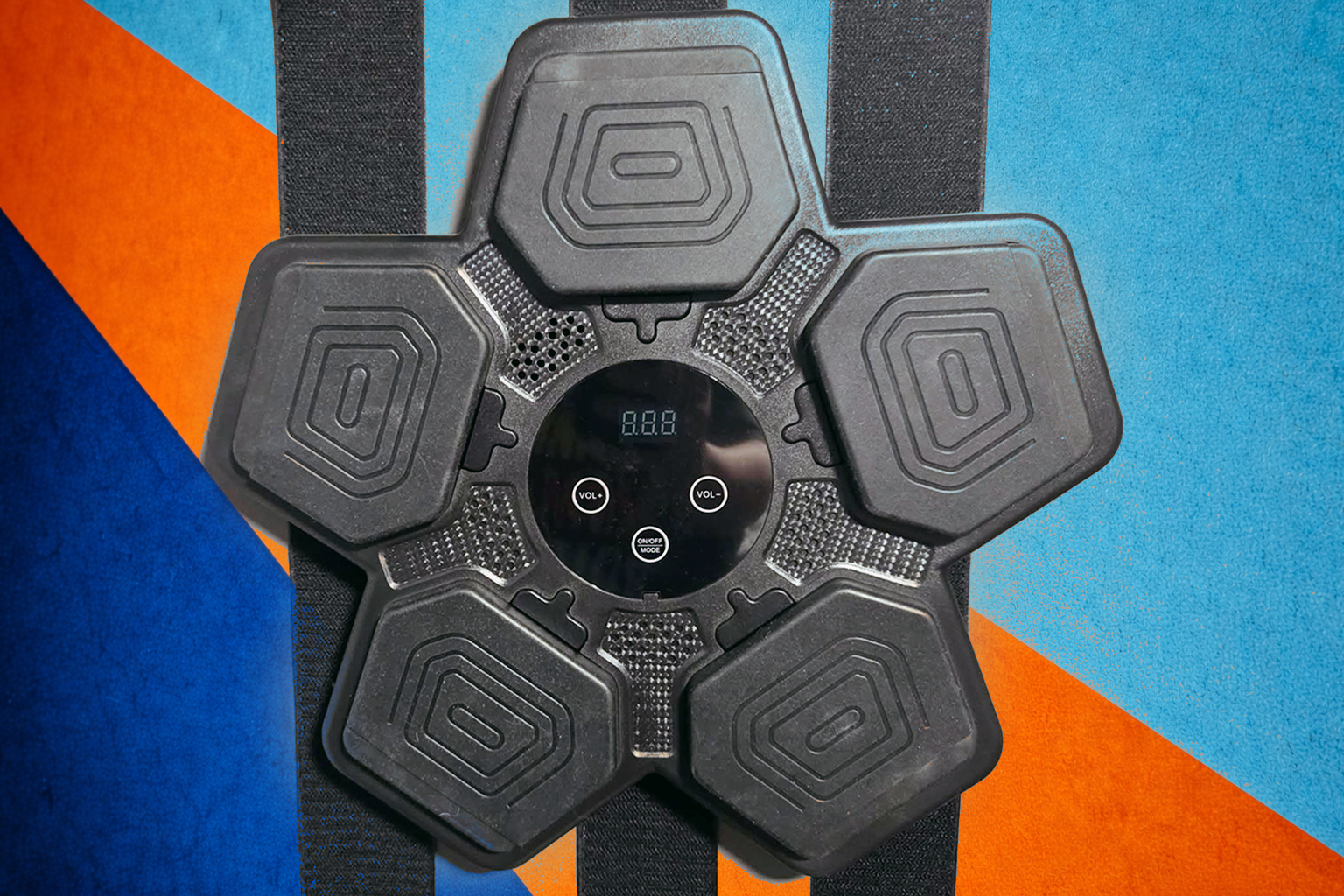
It’s a wall-mounted punching pad that lights up and syncs with music. Targets flash. You hit them on rhythm. Stay quick. Stay accurate. Keep moving. Punch hard. Very hard…
It’s marketed for adults, kids, home gyms, even offices. You just need a sturdy wall.
It comes with gloves, installs fairly easily, and takes up very little space. That compact size is both a strength and a limitation.
The unit itself feels solid. Hard plastic outer shell, reinforced sections where you strike, internal sensors that register impact. There’s padding on the strike zones for safety, but to trigger consistent feedback, you need to hit with intention. This isn’t a tap-and-go device. It wants commitment.
I can confirm that part.
First Impressions and Setup
This music boxing machine review includes a detailed look at the setup process. Mounting the unit, powering it on, and syncing with music is straightforward, but understanding the compact size and precision required is key to getting the best experience.
Setup was straightforward. Mount it, power it on, wait for the lights. If you live in an apartment or don’t have room for large equipment, this is appealing. What surprised me was the size. It looks bigger online. In person, it’s more compact. After years of VR boxing where targets are large and forgiving, this felt tight. More precise. Less room for error.
And unlike VR, there is no haptic vibration through a controller. You feel real impact through your hands and into the wall behind it. That changes the experience immediately.
Will says, “I blinked and missed three targets.” He claims he has an advantage because of his beaver tail for balance. I cannot confirm or deny this.
What It Feels Like to Use
Here’s where I want to be honest.
To get consistent scoring, you have to punch with purpose. Light taps often do not register cleanly. That shifts your focus. Instead of flowing naturally, I caught myself thinking, “Did that count?” more than I wanted to. In VR, I use my hips, core, and rotation. I throw straights, crosses, uppercuts, defensive slips. This machine is mostly straight punches. Quick extensions. Very linear. It becomes more about speed and accuracy in a small window than full-body mechanics. Because of that, I personally would not use this long term as my main workout. I can see myself getting bored or slightly frustrated over months. For me, sustainability matters more than novelty.
That said, it does have a place.
Where the Music Boxing Machine Actually Shines
If your goal is reaction speed, this has something VR cannot fully replicate.
There is no motion prediction. No controller smoothing. No software compensating for slightly off timing. A light flashes. You either hit it or you do not. That raw feedback trains quick decision making and sharp hand-eye coordination.
I could see this being great for:
- Light cardio days
- Short movement breaks between work
- Parents who want kids moving without screens
- VR users who need a break from wearing a headset
- Quick warmups before a longer workout
Will says, “It made my paws faster. Not my patience.”
Accurate.
The Science Behind Reaction Training
Now let’s talk about what is actually happening in your body.
When a light flashes, your visual system detects the stimulus. That signal travels from your retina through the optic nerve to the visual cortex in your brain. From there, your brain processes what it sees, decides on a response, and sends a signal down through the motor cortex, into your spinal cord, and out to the muscles in your shoulder, arm, and hand. Will made me say this…but its great information to know.
That entire loop happens in fractions of a second.
Training tools like this work on neuromuscular efficiency. The more you repeat that stimulus-response cycle, the more efficient the neural pathways become. Synaptic connections strengthen. Reaction time can improve. Motor unit recruitment becomes more coordinated.
You are not just training muscles. You are training the communication between your brain and your muscles.
There is also a cognitive component. Anticipation improves. Pattern recognition gets sharper. Your brain starts predicting timing instead of only reacting to it.
However, there is an important principle in exercise science called adherence. The most effective program is the one you stick with. If feedback feels inconsistent or frustrating, motivation drops. When motivation drops, frequency drops. And without repetition, adaptation slows down.
Will adds, “Results only work if you show up.”
He is not wrong.
How It Fits Into a VR Fitness Setup
For someone like me who already trains in VR, I see this as a supplement, not a replacement.
It could work as:
- A five to ten minute warmup
- A reflex finisher after VR boxing
- A quick workout on days when you do not feel like wearing a headset
One big advantage is comfort. No sweat on lenses. No headset pressure. No adjusting straps mid-session. Some days, that alone is appealing.
But it does not replace the full-body engagement, movement variety, and immersive experience of VR boxing.
It fills a different role.
MY VR FITNESS SETUP (WHAT I USE DAILY) If you’re doing VR fitness regularly, here’s what actually makes it sustainable:
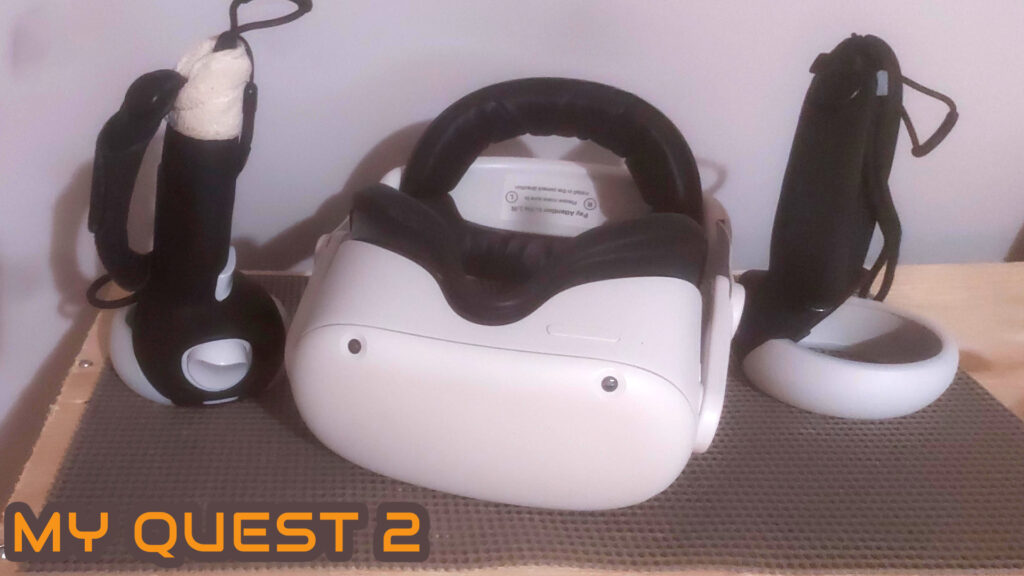
Meta Quest 2 I have but i don’t think they sell it anymore, go to the QUEST3 my next big purchase (check current price) My VR headset. Works with all VR fitness apps.
15lb Kettlebell (check current price) – I do a 5-minute warm-up before VR boxing. Reduces injuries to zero.
Microfiber Cloth (check current price) – Keeps lenses clear during cardio sessions.
VR Head Strap (check current price) – Way more comfortable for 30+ minute workouts.
Floor Fan (check current price) – Prevents lens fogging and keeps you cool. These aren’t expensive, but they make VR fitness way more enjoyable long-term.
Final Thoughts and Beaver Verdict
Would I recommend this to everyone? No.
Overall, the music boxing machine is a compact, fun, and effective tool for home workouts that improves hand-eye coordination, reflexes, and short cardio sessions without wearing a VR headset. While it does not replace full-body VR boxing workouts like Supernatural VR, it works perfectly for quick warmups, supplemental reflex training, or VR-free exercise days. Its rhythm-based targets provide immediate feedback, making it ideal for reaction speed, focus, and pattern recognition. For anyone looking for a music-driven, home-friendly way to train reflexes and stay active, this music boxing machine offers a practical and engaging option that fits neatly into a daily fitness routine.
I do not regret trying it. I just know myself well enough to admit it would not hold my attention long term. This music boxing machine review shows it can be a valuable tool for reflex training, quick cardio, or short VR-free workouts. It offers unique benefits like hand-eye coordination improvement and compact home-friendly design while remaining motivating and mentally stimulating.
As a unique addition to any home fitness setup, the music boxing machine provides real-time, rhythm-based feedback without needing a headset, allowing short warmups, supplemental workouts, or VR-free sessions. By hitting the flashing targets in time with music, it trains reaction speed, focus, and pattern recognition while strengthening neuromuscular efficiency. For VR users, it complements full-body workouts by providing reflex finishers or active breaks without sweat on lenses or adjusting headset straps. Suitable for adults, teens, or kids, it fits in small spaces, encourages consistent practice, and offers a fun, music-driven way to stay active while enhancing reflexes, coordination, and cardiovascular activity.
Will’s final verdict:
“Fun idea. Small target. Either make the pad bigger or recruit stronger beavers. Also, if the goal is reflex training, why make me hit it like I’m trying to knock down a tree?”
Fair point.
Affiliate Disclosure
As an Amazon Associate, I earn from qualifying purchases. If you click a link and buy something, I may earn a small commission at no extra cost to you. I only recommend products I personally own and use.